Getting electricity and water meters for a knock-down house: steps and costs
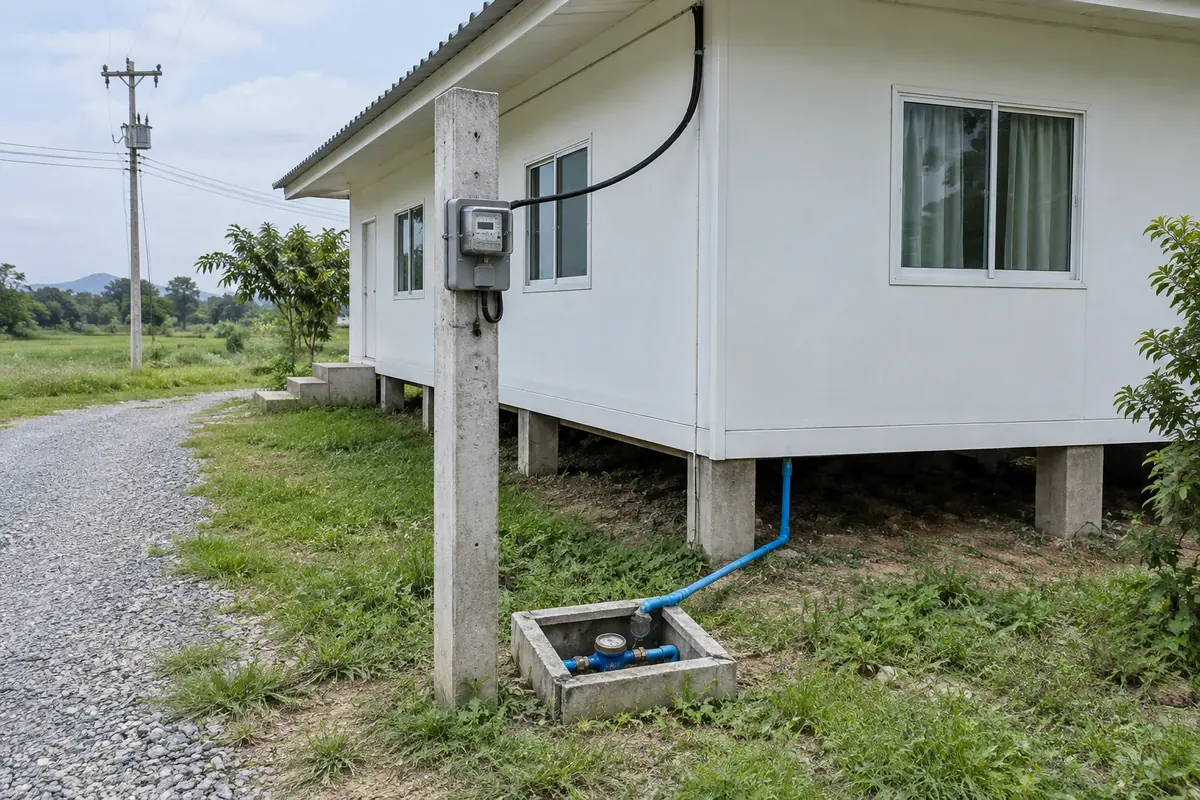
Contents
In short
- If your land is in Bangkok, Nonthaburi or Samut Prakan, apply for an electricity meter to the Metropolitan Electricity Authority; in other provinces, apply to the Provincial Electricity Authority. Generally, the house needs a house number and must pass an inspection of the internal wiring first.
- In our example, an air conditioner rated at 12,000 BTU plus a water heater draw about 27.5 A between them, so the house should have a 15(45) A meter. Without the water heater, a 5(15) A meter may be enough.
- As of November 2026, PEA charges ฿400 for inspection plus deposit on a 5(15) A meter and ฿2,700 on a 15(45) A meter, before VAT. MEA charges ฿700 for inspection and takes no deposit from new residential customers.
- For a 1/2-inch water meter, labour and materials cost ฿3,600 with PWA and ฿5,000 with MWA. If the land is far from the power poles or water main, the cost rises sharply.
Who to apply to for an electricity meter, and what must be ready first
You apply to the electricity authority that covers the area; generally, the house needs a house number and internal wiring ready for inspection. The Provincial Electricity Authority (PEA) is responsible for 74 provinces. The other three, namely Bangkok, Nonthaburi and Samut Prakan, are looked after by the Metropolitan Electricity Authority (MEA). Mains water is split the same way, between the Metropolitan Waterworks Authority (MWA) and the Provincial Waterworks Authority (PWA).
The public service guide on PEA's website for meters from 5(15) to 30(100) A sets four conditions.
- A PEA low-voltage distribution line runs past the site.
- The site has a house number. If it does not yet, read Can a knock-down house get a house number, and what documents do you need?
- The applicant must run the main cable from the house to the power pole.
- The wiring and fittings in the house are installed to the standard of the Engineering Institute of Thailand or to PEA's own standard.
Choosing the meter size from the appliances in the house
On a meter marked, say, 15(45) A, the first figure is the rated current and the figure in brackets is the maximum it can take. At PEA, a three-phase meter carries a higher deposit than a single-phase one of the same size. You can estimate the current by dividing watts by 220 volts, the voltage of single-phase household power.
| Appliance | Power | Approximate current |
|---|---|---|
| 12,000 BTU inverter air conditioner | 973 W, up to 1,300 W | 4.4–5.9 A |
| Water heater | about 4,750 W | about 21.6 A |
| Both running at full power together | 6,050 W | about 27.5 A |
The air conditioner's power comes from the specification of one model sold in Thailand. The water heater figure comes from an MEA article of June 2026 that says it uses about 4.75 units an hour. A fridge, fans and lights use much less, but you must add them from the labels on the actual appliances.
- Reading the result: MEA's temporary-supply fee table pairs use of up to 30 A with a 15(45) meter and 31–75 A with a 30(100) meter, so the example house should have a 15(45) A meter. Take the water heater out and the load falls below 15 A, the maximum for a 5(15) meter. Have an electrician add up the watts from the real labels before you apply.
- Effect on the bill: PEA's tariff from the September 2026 bill puts meters of up to 5 A in category 1.1.1, with a service charge of ฿8.19 a month. A larger meter, or use of more than 150 units for 3 months in a row, puts you in category 1.1.2, with a service charge of ฿24.62.
Fees and deposits as of November 2026
Figures from both authorities' service-rate pages, checked on 12 November 2026; they may change.
| Meter | PEA inspection + deposit | MEA inspection |
|---|---|---|
| 5(15) A single-phase | ฿100 + ฿300 = ฿400 | ฿700 |
| 15(45) A single-phase | ฿700 + ฿2,000 = ฿2,700 | ฿700 |
| 30(100) A single-phase | ฿700 + ฿4,000 = ฿4,700 | ฿700 |
| 15(45) A three-phase | ฿700 + ฿6,000 = ฿6,700 | ฿700 |
| 30(100) A three-phase | ฿1,500 + ฿12,000 = ฿13,500 | ฿1,500 |
- PEA: the connection fee is waived for all sizes. This table has applied since 1 January 2020 and excludes VAT. PEA's guide gives the fee for a 5(15) A meter as ฿107 including VAT.
- MEA: the inspection fee is ฿0 if you use an internal wiring installer registered with MEA, and MEA takes no deposit from new residential applicants. The page does not say whether VAT is included.
This is only the utility's share. The seller we cite in What kind of knock-down house can ฿50,000 buy? puts the whole connection job at ฿5,000–15,000, including the main cable, the fuse box and the electrician's labour. Ask for an itemised quote.
Documents, steps and online channels
- PEA: your ID card or the ThaID app; the house or building register of the site; a document showing ownership or possession rights; and a location map. The applicant must be the owner, have the owner's written consent, or hold rights under a contract such as a lease. Apply at an office, on the e-Service website, in the PEA Smart Plus app or through the official LINE account, PEA Thailand.
- MEA: an ID card or passport, plus a copy of the house register or a house number notification letter. If you are already listed in the house register of that site, MEA checks the government database itself. Apply through MEA e-Service or book a queue at an MEA district office.
- Get the house number first.
- An electrician wires the house, fits the fuse box and runs the main cable to the point the utility specifies.
- Apply and choose the meter size.
- The utility books a wiring inspection. If it fails, fix it and book again.
- Pay the fee and deposit, then sign the electricity supply contract.
- The meter is installed. PEA sets this at within 2 working days in municipal areas or 5 working days outside, counted from the day after payment.
What the utility checks before connecting
Besides the standards condition in the first section, PEA's guide says that if the inspection fails, the work must be corrected first and PEA reserves the right not to supply power yet; it gives no item-by-item checklist. MEA's website gives this safety advice.
- Sockets should be three-pin with an earth, certified to TIS 166-2549.
- Wiring must follow the Electrical Installation Standard for Thailand.
- The electrical system should be earthed and have an automatic cut-off device.
Ask the seller whether the electrical work in the price includes the fuse box, earthing, a residual-current device, and how long the main cable is. If you need to drill extra holes in the walls, see What is a knock-down house made of, and how can you tell it is well built?
A temporary meter is only for the waiting period
- PEA: category 8, temporary electricity, covers construction, places without a house registration and supply that does not yet comply with the rules. It costs ฿6.8025 per unit, compared with ฿3.0000 per unit for the first 200 units in residential category 1.1.2; both rates exclude Ft and VAT.
- MEA: a temporary supply of up to 30 A uses a 15(45) single-phase meter, with a ฿400 connection fee and a ฿2,000 deposit if it is used while building your own house or in your own house; in other cases the deposit is ฿10,000. A guarantee of outstanding debts signed by the landowner is required; without it, the deposit is doubled.
If the land is far from the power poles, the grid must be extended
If the utility's line does not reach the land yet, you must first apply for a grid extension under PEA's rules. Putting up poles and lines costs many times more than the meter. The public consultation document for PEA's phase 3 project to extend power to rural homes, covering 2024–2028, sets a budget of ฿6,500 million for about 130,000 households, an average of about ฿50,000 per household, and accepts homes costing no more than ฿75,000 per household. The project accepts homes where people actually live and that have a house registration, or a temporary house registration with consent from the owner of the area, and they must have a public road that vehicles can use in all seasons.
A holiday house nobody lives in permanently may therefore not qualify. Before buying land, ask the electricity office whether an extension is needed and ask for a cost estimate. For truck access and clearance from power lines while lifting the house, see Preparing your site: ground, supports and truck access
Mains water: PWA or MWA
The smallest meter in both agencies' tables is 1/2 inch, which PEA's guide says suits use of up to about 43 cubic metres a day. The figures below are from the two agencies' sites as of November 2026.
| 1/2-inch meter | PWA | MWA |
|---|---|---|
| Advance deposit | None | None |
| Water-use deposit | ฿500, waived for residential users | Not in the table |
| Labour and materials | ฿3,600 | ฿5,000 |
| Distance this price covers | Meter to main up to 10 m | Branch pipe to meter up to 20 m |
| Monthly service charge | ฿30 | ฿25 |
Both tables say VAT is excluded, but another part of PWA's page says the flat price includes VAT, so ask the branch. MWA charges any pipe beyond the covered length at actual cost, and the pipe from the meter into the house is the owner's job. See Prefab toilets: how they are installed and plumbed
- PWA: your ID card, plus a copy of the house register for the connection point if it differs from the address on your card. If you are not the householder, you need the householder's letter of consent, proof of ownership or a lease. Apply at a branch or through the new-connection system on PWA's website, then pay within 60 days of being told the price.
- MWA: a copy of your ID card plus one document such as the house register, a building lease, a temporary house registration or a building permit. A house with a temporary house registration gets a temporary connection and pays an extra ฿500 to fit a tap.
If there is no water main
Use a storage tank with a pump, or drill a well. A 2011 notification of the Ministry of Natural Resources and Environment treats underground water deeper than 15 metres as groundwater; drilling to that depth needs a permit, and the water must be treated before drinking. Ask the local groundwater resources office, and ask the tambon administrative organisation or municipality whether there is a local water supply.
Frequently asked questions
Can I get an electricity meter without a house number?
A permanent PEA meter requires a house number, and a place without a house registration falls under the temporary electricity tariff, which costs more. MEA accepts some cases using land title documents or other documents it specifies instead. The easier route is to get a house number first.
Can I take power from the existing house on the same land?
PEA's residential tariff covers a house and its related areas connected through one meter, so you can use the main house's meter if it is big enough. Have an electrician add up the load of both buildings first; if it is too much, the meter may need to be upsized.
Do I get the deposit back?
PEA returns the deposit when the contract ends, and its guide says within 20 working days of receiving complete documents. MEA takes no deposit from new residential customers, and PWA takes no water-use deposit from residential users.
How long does it take to get a meter?
After payment, PEA installs the meter and connects power within 2 working days in municipal areas and 5 working days outside, under its Regulation on Service Quality Standards B.E. 2563 (2020), not counting the wait for an inspection. For water, the joint PEA and PWA guide of 2020 says a pipe of up to 10 metres is installed within 3 working days of payment.
Keep reading
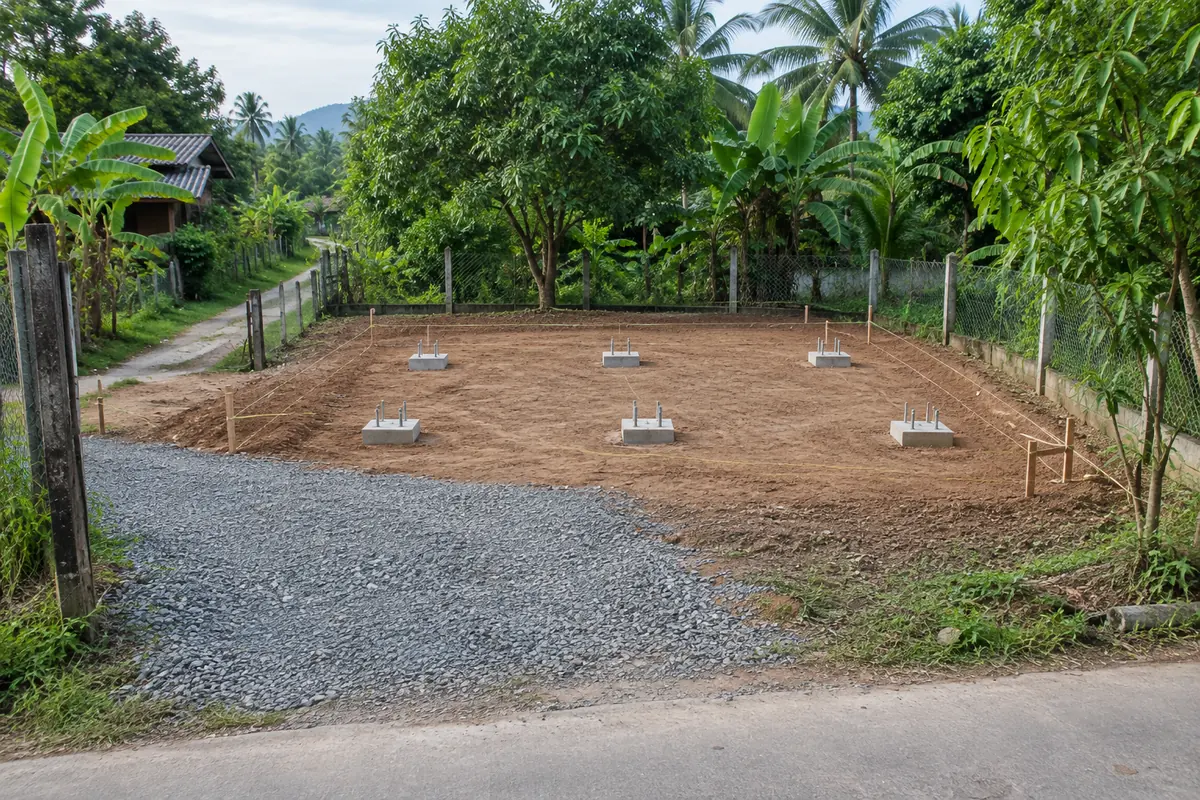
Preparing your site: ground, supports and truck access
A delivery-day checklist, from ground level and where the house sits to access for the delivery truck and crane.
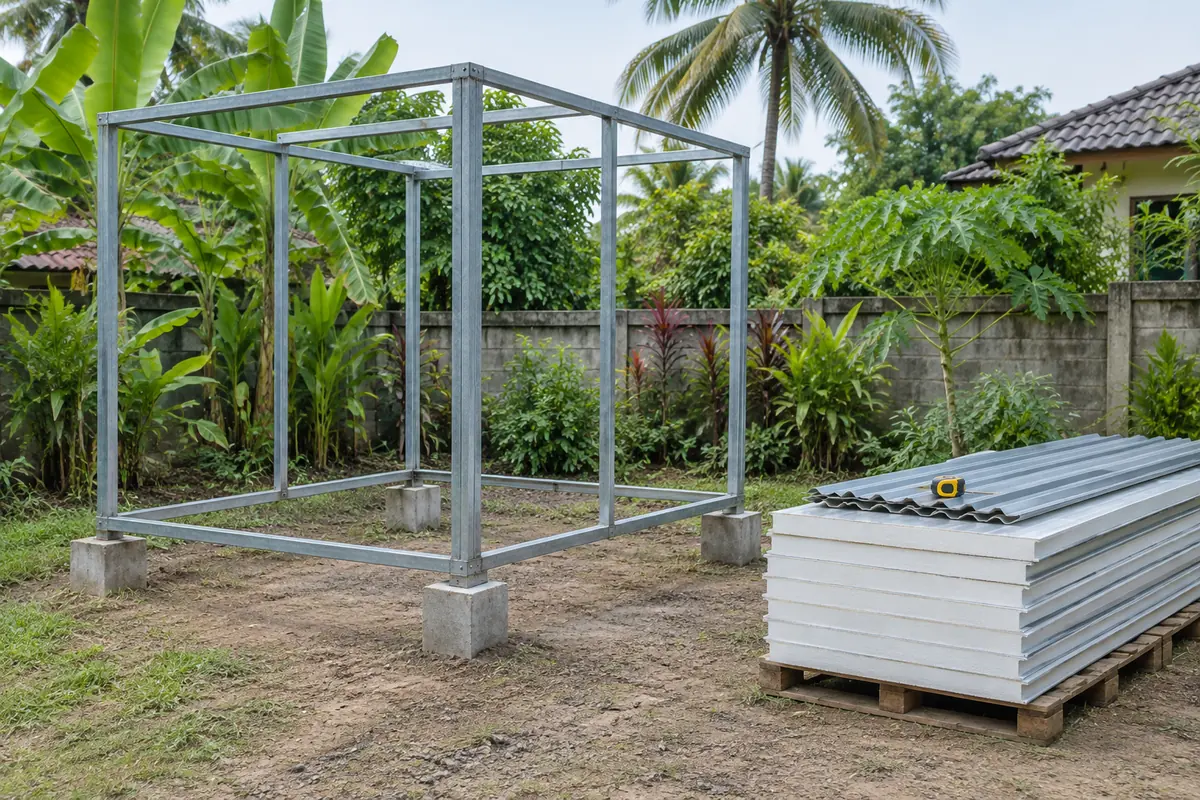
A knock-down house for ฿20,000–30,000: what can you get?
Advertised prices at ฿10,000, ฿20,000 and ฿30,000, what each level still leaves out, and a worked materials estimate for building a 2.4×2.4 m room yourself.
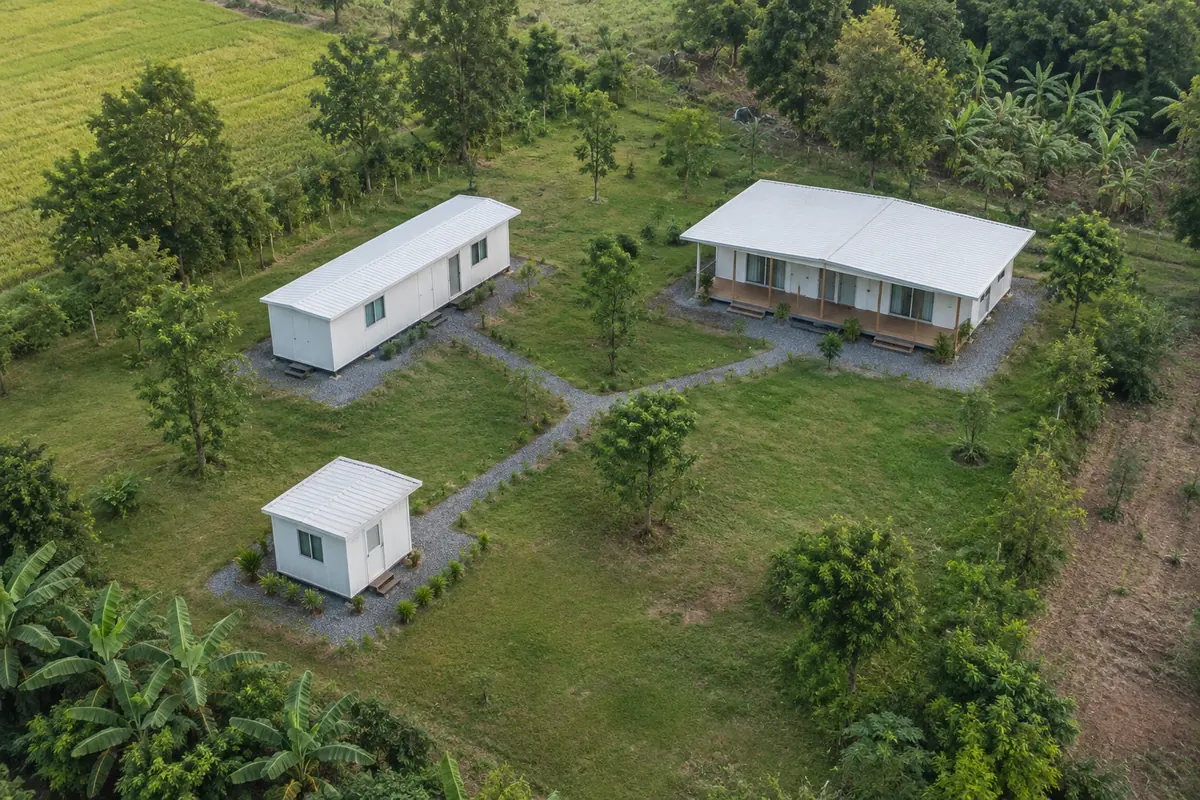
Knock-down house floor plans in five sizes, from a 3×3 m room to a 6×9 m joined house
To-scale plans of 3×3, 3×4 and 3×6 m rooms and 6×6 and 6×9 m joined houses, with usable area after the walls, furniture sizes and how many people each suits.