Can a knock-down house get a house number, and what documents do you need?
Contents
In short
- A knock-down house that people live in can get a house number, because the civil registration law looks at whether it is used as a home, not at how it was built.
- The householder must notify the registrar within 15 days of the house being finished. Notifying is free; if you are late, you pay a late-notification fee.
- The public service guide asks for the notifier's ID card and, if you have them, the land title document and the building permit documents.
- If you cannot show evidence of a building permit or of rights to the land, the registrar records it as a temporary house registration, which matters when you apply for water and electricity.
Can a knock-down house get a house number?
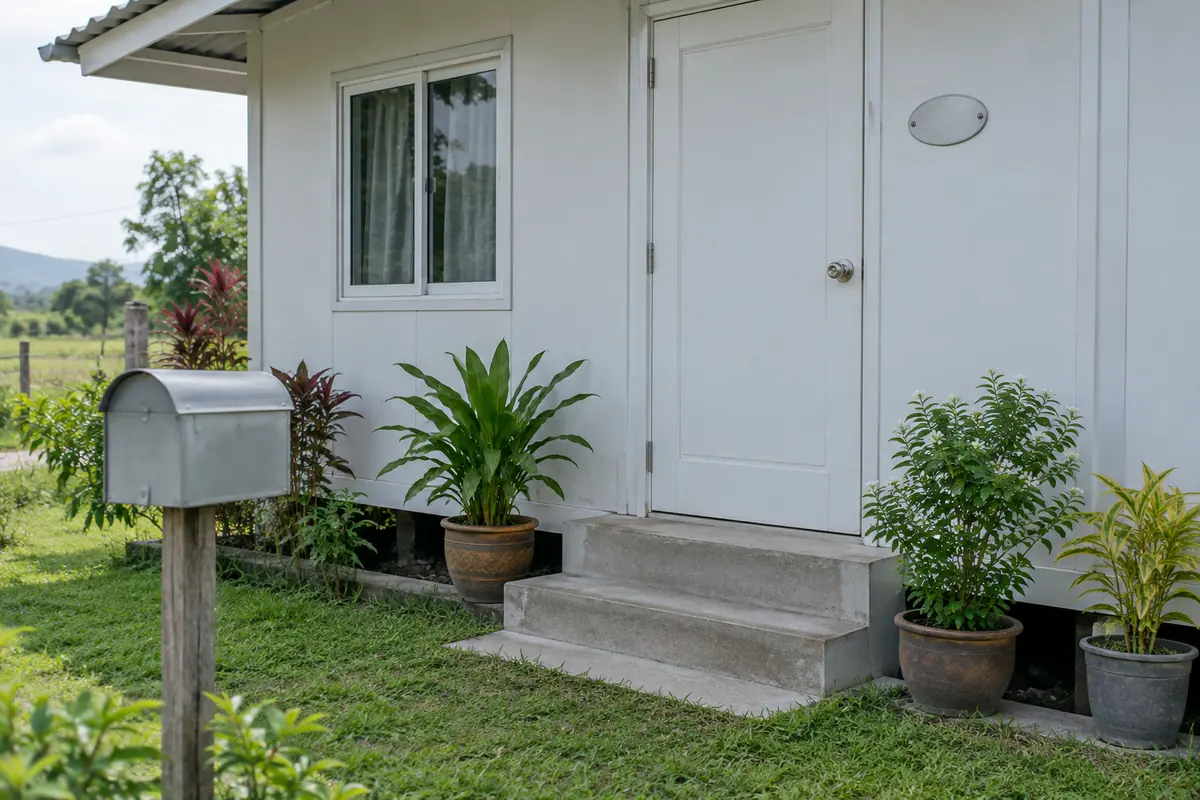
Yes, if it is used as a home. Section 4 of the Civil Registration Act B.E. 2534 (1991) defines a house as a building or structure used as a dwelling and possessed by a householder, and it also counts rafts, boats and vehicles that people live in regularly. So the law looks at how the place is used, not at whether the house can be taken apart or what kind of base it stands on.
Section 34, as amended by the Civil Registration Act (No. 3) B.E. 2562 (2019), says every house must have a house number, and the householder of a house without one must apply for it. Getting a building permit under the Building Control Act is a separate matter that has to be done on its own. Read more in Do you need a permit to place a knock-down house on your land?
- Used as a shop or storeroom: the Ministerial Regulation of 2019 on buildings built for purposes other than housing lists buildings used for commerce or business services, and buildings for storing goods or things. These get a building number and a building register instead of a house number. If you plan to open a shop, read more in Knock-down shops and kiosks
- Placed inside the same fence as an existing house: Section 35 lets several houses in the same area share one number. If the householder wants a separate number, they can apply for one. Decide first whether you want a separate house register and a separate meter.
This article is general information from the law and official guides that we checked in November 2026. In each case, the local registrar makes the decision.
How many days you have, who applies and where
- Deadline: Section 34 paragraph one says to notify within 15 days of the day the house is finished. A knock-down house is often installed in a few days, so write down the date installation was completed. If you are unsure which day counts, ask the registrar.
- Who applies: the householder, or someone the householder authorises. Under Section 4, a person who possesses the house as owner, tenant or in any other capacity can be the householder. If there is no householder or the householder is away, the person looking after the house at the time is treated as the householder.
- Where: the district registration office or local registration office for the area where the house stands, such as the amphoe office, the municipal office or, in Bangkok, the khet (district) office. Call first to ask which registration office covers your plot.
- Fee and time: the public service guide says there is no fee and the visit takes about 20 minutes when the documents are complete. Section 34 paragraph two gives the registrar 7 days to assign the number if the house is inside a local registration office's area, or 30 days if it is outside, counted from the day the application is received.
- If you are late: Section 51 still lets you notify, but you must pay the late-notification fee set by ministerial regulation. The schedule attached to the Act caps it at ฿1,000 per occasion.
Once you have the number, Section 34 says to fix it where it can be clearly seen. If there is a good reason, the householder can also ask for a number and a temporary house registration before the house is finished; the registrar then notes that it is under construction.
What documents do you need for a house number?
The list below comes from the public service guide on requesting a house number. The Bureau of Registration Administration of the Department of Provincial Administration owns the procedure, and many local registration offices publish the guide. It cites Clause 32 of the Central Registration Office Regulation on Civil Registration B.E. 2535 (1992).
| Document | Form | Note |
|---|---|---|
| Notifier's national ID card | Original | Required |
| House notification receipt (Tor Ror 9) | Original | If you have one |
| Land ownership document | Copy | If you have one |
| Building permit documents under the Building Control Act | Original | If you have them |
"If you have one" does not mean it is unimportant. The last two documents decide whether you get a normal or a temporary house registration. The items below are not in the guide, but it is worth preparing them and asking the registration office whether they are needed.
- A consent letter signed by the landowner, with a copy of their ID card, or a land lease, if the house stands on someone else's land.
- A letter or confirmation from the local authority if this house does not need a building permit.
- A location map and photos of the house, so the officials can find it easily.
- A power of attorney if the householder will not apply in person.
If there is no permit, or the land is not yours
Section 36 paragraph four, amended in 2019, says that if the applicant does not show evidence of a building permit, or evidence of ownership or possession rights to the land, the registrar records the register as temporary. The public service guides therefore have a separate procedure called "requesting a house number for a temporary house registration", which uses the same documents as the table above.
- A house number is not evidence of land rights: Section 34 paragraph four says house numbers and house registers exist for public order and to protect people's basic rights, and no one may cite them to show that they have rights to, or own, the land.
- The registrar may check the facts: the guide says that if there is reason to suspect a notification is unlawful or the details are untrue, the registrar investigates, questions witnesses and decides within 7 days. A complex case must be referred to the Central Registration Office, which can take up to 90 days.
- A house register does not replace a permit: getting a house number is a matter under the civil registration law; it does not show that the house has the right building permit. If your area requires one, talk to the local authority about the permit at the same time.
What a temporary house registration means in practice
A temporary house registration still gives the house a number, but several utilities have separate rules for it. The examples below come from the agencies' own websites and documents, checked in November 2026.
- Metropolitan Waterworks Authority (MWA): permanent water connections are for buildings with a lawful house registration; a house with a temporary house registration gets a temporary connection, and temporary water use carries an extra ฿500 charge for fitting one tap.
- Provincial Waterworks Authority (PWA): if you have a letter of consent from the state agency that owns or manages the land, you are charged like any other customer. Without one, PWA collects a temporary-use water deposit. If there is a land encroachment dispute with a state agency, installation is put on hold, and the right to use water ends at once when the agency that owns the land says the area may no longer be used.
- Provincial Electricity Authority (PEA): the residential tariff covers continuous residential use that does not yet have a permanent house registration. A place with no house registration at all falls under the temporary electricity tariff, at ฿6.8025 per unit.
- PEA grid extension project, phase 3: it accepts houses with a temporary house registration only when the owner of the land has given written consent and people actually live there.
In short, a temporary house registration lets you get water and electricity in many cases, but written consent from whoever holds the land rights is often the deciding factor. If you later get a permit or land documents, ask the registrar what to submit to change it to a normal house registration.
Why a house number matters for a knock-down house
- Electricity meter: PEA's application guide makes a house number at the site a condition, and asks for the house or building register of that site. The Metropolitan Electricity Authority accepts a copy of the house register or a house number notification letter. Details are in Getting electricity and water meters for a knock-down house
- Mains water: PWA asks for a copy of the house register for the site. If the site has no house register, you need a document showing ownership instead.
- Moving names in: Section 36 provides a house register for each house that has a house number, and Section 30/1 makes the householder report, within 15 days of moving in, anyone who moves in intending to make it their domicile. A house with no number cannot take anyone's name yet.
- Contact address: for letters and parcels, and for filling in your address on documents.
Applying for a new house number, step by step
- Before buying the house, check with the local authority whether a house of this size needs a building permit, and keep any documents you receive.
- If the land is not yours, sign a lease or get a letter of consent from the owner before the house is placed.
- Write down the date installation was finished, because the 15 days start from the day the house is finished.
- Call the registration office to ask which office covers the land and what extra documents are needed.
- The householder applies with their ID card, the land documents and the permit if there is one, or authorises someone else to go.
- Wait for the decision. If the registrar has doubts about the facts, they may ask for further checks.
- Once you have the number, put it up where it is clearly visible and keep a copy of the house register for other applications.
- Move in the names of the people who will live there, then apply for the electricity and water meters.
Frequently asked questions
If I put a second knock-down house inside the same fence, do I need a new number?
Not necessarily. Section 35 lets several houses in the same area share one number. If you want a separate house register or a separate meter, apply to the registrar for an extra number. If it is a spare room for the main house, read more in A small house in the garden
If I rent someone else's land for the house, who is the householder?
The tenant can be the householder, because the law counts a person who possesses the house as a tenant. But without evidence of land rights or a building permit, you may get a temporary house registration. Put the lease in writing, have the landowner sign a consent letter, and ask the registrar whether these documents will do.
Once I have a house number, can I use it to show I own the land?
No. Section 34 paragraph four forbids citing a house number or house register to show rights to or ownership of land. Land rights are shown only by land documents or contracts.
Does a house number cost anything?
The public service guide says there is no fee. If you notify after 15 days, you pay the late-notification fee set by ministerial regulation, which the Act caps at ฿1,000 per occasion. Other possible costs are photocopies and travel.
Keep reading
Do you need a permit to place a knock-down house on your land?
Questions to ask the district office or municipality before placing the house, and documents to prepare in advance.
A knock-down house for ฿20,000–30,000: what can you get?
Advertised prices at ฿10,000, ฿20,000 and ฿30,000, what each level still leaves out, and a worked materials estimate for building a 2.4×2.4 m room yourself.
Knock-down house floor plans in five sizes, from a 3×3 m room to a 6×9 m joined house
To-scale plans of 3×3, 3×4 and 3×6 m rooms and 6×6 and 6×9 m joined houses, with usable area after the walls, furniture sizes and how many people each suits.