Knock-down shops and kiosks: choosing the right size and design
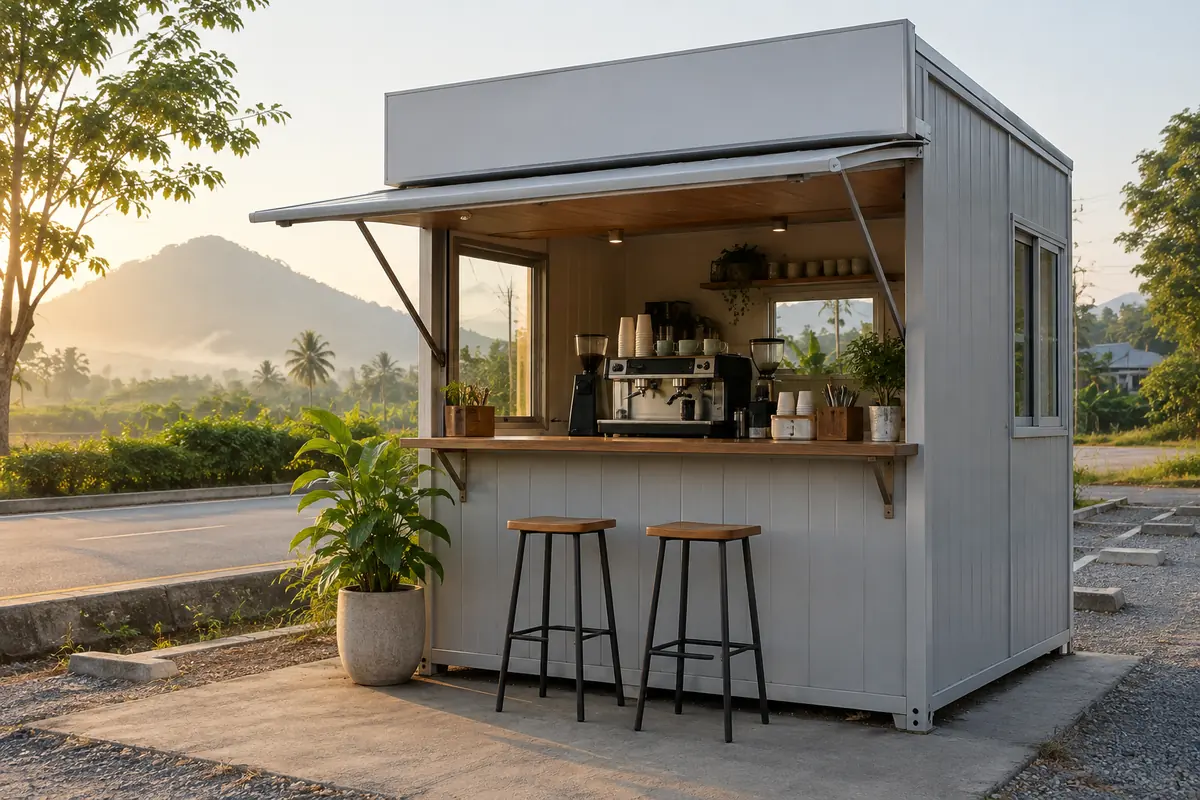
Contents
In short
- A folding market stall suits weekly markets where you set up and pack away every day. A knock-down kiosk or shop suits a fixed spot where you can connect power and water and lock up overnight.
- A 2×2 m kiosk is enough for one person serving. If two people work at the same time, or you need to prepare food, look at about 3×3 m or larger.
- Add up the wattage of every appliance before you order. A small coffee kiosk with an espresso machine, blender, fridges and air conditioning can draw about 25–30 amps in total.
- A food outlet of no more than 200 m² must notify the local authority for a notification certificate under the Public Health Act, and the kiosk itself may also need a permit as a building.
Folding market stall or knock-down shop: which one?
It depends on whether you will sell from the same spot every day. If you trade at a market a few days a week and take everything home each time, a folding stall or pop-up tent costs far less. If you have a fixed spot, such as in front of your house or on land by a road, a knock-down shop or kiosk that stays in place saves setting up every morning, and the wiring for power-hungry equipment can be permanent.
| Point | Folding stall or tent | Knock-down kiosk or shop |
|---|---|---|
| Setting up | Put up and taken down by you every day | Lifted into place once with a truck-mounted crane |
| Advertised price | 2×2 m pop-up tent about ฿1,400–2,000 | 2×2 m kiosk from about ฿29,900 |
| Power and water | Whatever the market provides, or none | Permanent wiring, sink and drain pipe |
Section 38 of the Public Health Act B.E. 2535 (1992) treats selling in a market separately from food premises, so traders in a market follow that market's rules. Setting up a stall on a pavement or other public place is a separate matter and needs local authority permission first.
Common kiosk sizes and what fits in them
Sizes in sellers' listings run from about 1.5×1.8 m to 3×7 m. The first figure to check is the depth from the serving hatch to the back wall, because it has to hold a front counter, a working aisle and a back counter.
Working it out: one kitchen base cabinet sold in Thailand is 60 cm deep. A kiosk 2 m deep with counters like this at the front and back leaves an aisle of about 80 cm before the walls are taken off. The kitchen planning guidelines of the US National Kitchen & Bath Association recommend a work aisle of at least 107 cm for one person and 122 cm for more than one. For two people to pass each other, the inside depth needs to be about 0.60 + 1.22 + 0.60 = 2.42 m.
| Size | Staff | Suits |
|---|---|---|
| 1.5×1.8 m | 1 | Simple drinks, or goods that need no water |
| 2×2 m | 1 | Coffee, tea and smoothies, with a small sink and one fridge |
| 2×3 m | 1–2 | A longer menu, or shelves of goods along the side |
| 3×3 to 3×4 m | 2 | Food that needs preparing, or a shop customers walk into |
The hatch should face the direction customers come from, and there must be room in front for a queue that does not spill onto the road. If customers walk inside, the same guidelines recommend a walkway at least 91 cm wide.
Shop front, serving hatch and counter height
- Top-hung or lift-up awning window: open, it becomes a canopy for customers; closed, it is a solid wall. Ask whether it has stays to hold it up and a bolt that locks from inside.
- Sliding window: nothing sticks out of the kiosk, so it suits a spot right next to a walkway, but a two-pane slider opens only about half the frame and gives the queue no shelter from rain.
- Glass front: good for displaying goods, but if it faces west the afternoon sun comes straight in.
The kitchen cabinet mentioned above is 82.5 cm high. The same association's guidelines suggest two counter heights, 71–91 cm and 91–114 cm. A small kiosk can use the lower level for making drinks and preparing food, and the higher one as a ledge for taking payment or handing over cups. For food or drink sales, the 2018 Ministerial Regulation on Hygiene of Food Premises (B.E. 2561) requires utensils and equipment, and drinks made on site, to be kept at least 60 cm above the floor. Ice containers must stand at least 15 cm off the floor with the rim at least 60 cm high. Shelves lower than this should hold other things.
Electricity: add up every appliance before you order
This example is a coffee kiosk of 2×2 m, using the rated power of appliances that Thai shops sell (checked November 2026).
| Appliance | Rated power |
|---|---|
| Espresso machine, single group head, two separate boilers | 3,350 W |
| Blender, 2 litres | 1,400 W |
| Coffee grinder | 350 W |
| Single-door drinks fridge, 338 litres | 290 W |
| Chest freezer, 7 cu ft | 100 W |
| Three 18 W LED batten lights | 54 W |
| Total | 5,544 W |
Divided by the 220-volt household supply, that is about 25 amps when everything runs at once. Add a 9,000 BTU air conditioner, which most specifications list at about 800–1,000 W, and it rises to about 29–30 amps. An article on choosing a meter explains that a 5(15) meter suits use of up to 10 amps and a 15(45) meter suits 11–30 amps, so this kiosk is at the top end of a 15(45) meter. For how to apply for a meter, read Applying for electricity and water meters
- Separate circuits: have the electrician put power-hungry equipment, such as the espresso machine and air conditioner, on separate circuits, and size the cables and breakers from your actual list of appliances. Send the seller a plan of where each appliance goes before production too.
- Residual current device: the electrical installation requirements used in Thailand call for circuits supplying power outside a building, and sockets within 1.5 m of the edge of a sink, to have an RCD rated at no more than 30 milliamps, and an earth wire is needed too.
Clean water, waste water and hand washing
The same ministerial regulation has several points that need to be built into the kiosk.
- Water supply: it must be mains water. Where there is no mains supply, use water of equivalent quality or follow the public health officer's advice (clause 15).
- Hand washing: the area where food is made or cooked must have a hand-washing point (clause 3). If there is room, keep it separate from the sink for washing glasses.
- Greasy waste water: it must go through a grease trap before entering the drains, and the ground around the kiosk must not hold standing water (clause 6).
- Gas stoves: kiosks that cook with fuel must have fire protection equipment (clause 8), and you should ask what insulation core the walls have. See What is a knock-down house made of, and how can you tell it is well built?
If mains pipes do not reach the spot, a water tank and pump will do, but you need space for the tank and a socket for the pump. Pipe runs and pipe falls follow the same principles as in Installing a prefab bathroom: how to connect the pipes
Heat for the person inside
- Insulation: many kiosks priced in the tens of thousands of baht have single-skin metal-sheet or board walls. Ask whether the roof is insulated.
- Orientation: a cool-house guide from a Thai building-materials maker advises shading south- and west-facing walls in particular. If you can choose, do not face the hatch west.
- Canopy: a top-hung window or a canvas awning shades both the hatch and the queue.
- Air conditioning: one air-conditioner maker uses floor area × 800 BTU for a work room, plus 100 per m² if the room is under the roof. A 2×2 m kiosk has about 3.6 m² inside, which works out at about 3,200 BTU, below the smallest common size of 9,000 BTU. But if the hatch is open all day, the cool air keeps flowing out.
Advertised prices by size
| Type | Price advertised | Not included |
|---|---|---|
| 2×2 m pop-up tent, steel frame, fabric roof | about ฿1,400–2,000 | No walls, floor, power or lock |
| 1.5×1.8 m kiosk, metal sheet, with counter | about ฿25,900 | Delivery; wiring not mentioned |
| 2×2 m kiosk | about ฿29,900–45,990 | Some include lights, 3 sockets and a sink, some exclude wiring; ask about delivery |
| 2.2×2.2 m kiosk, single-skin board walls, 3 top-hung windows, lights and sink | about ฿42,000 | Sign, decoration and delivery |
| 2×3 m kiosk, metal sheet | about ฿42,900 | Delivery |
| 3×3 m shop, insulated walls throughout | from ฿149,999–169,999 | Delivery free only within Greater Bangkok |
| 3×7 m shop or café with a bathroom | from about ฿199,000–259,000 | Inclusions not itemised; buyer prepares the supports |
Data collected on 12 November 2026 from sale pages of shops in Thailand, on their own websites and on online marketplaces. The figures are examples and can change; our team did not contact the sellers for real prices, and almost no listing mentions VAT. The models in the tens of thousands have single-skin walls and those in the hundreds of thousands have insulated walls, so compare the specification along with the price.
Location, signs and moving the shop later
- Your own land: ask what the town-plan zone allows and whether a shop is permitted. In a housing estate, check the estate's by-laws as well.
- Rented land: get a written lease that states the term, how electricity and water are charged, whose name the meter is in, whether the landowner will sign a consent letter for applications to the local authority, and who pays to lift the shop out when the lease ends.
- Shop sign: signboard tax is paid to the local authority once a year. The rates in force since 1 January 2021 for signs with fixed wording are ฿5 per 500 cm² for Thai script only and ฿26 for Thai mixed with foreign script, with a minimum of ฿200 per sign. So a 60×200 cm sign with some English is 24 units × 26 = ฿624. These rates are as of November 2026 and may change.
- Moving the shop: one seller advertises lifting and transport at about ฿4,500–20,000 depending on distance. A truck-mounted crane must be able to reach the spot, and it helps to group the power and water connections in one place so they can be undone quickly. For truck access and supports, read Preparing your site: ground, supports and truck access
Permits to ask about before you open
Section 38 of the Public Health Act B.E. 2535 divides food premises by area. Above 200 m², you need a licence from the local authority; at 200 m² or less, you must notify the authority and obtain a notification certificate before opening. Kiosks of almost any size fall into the second group. One municipality's citizen guide says that once the notification is complete, you may start trading immediately. Fees follow each local authority's by-laws, and clause 21 of the 2018 ministerial regulation requires operators and food handlers to complete training.
If people can go inside and use the kiosk, the building control law may treat it as a building too. For details, see Do you need a permit to place a knock-down house on your land? For a shop selling goods other than food, ask about commercial registration as well. This section gives an overview as of November 2026 and is not legal advice. Take your shop plan to the municipality, subdistrict administrative organisation or district office before you commit to a kiosk.
Frequently asked questions
A knock-down shop for ฿30,000: what is possible?
Listings we saw include a 1.5×1.8 m kiosk for about ฿25,900 and a 2×2 m one for about ฿29,900, but neither price includes delivery or wiring. Once those are added, the total goes over ฿30,000. For other options, see A knock-down house on a budget of ฿20,000–30,000
Can an ordinary knock-down room be used as a shop?
Yes, but it needs a serving hatch, a counter and more sockets. Order them when the room is made, because cutting the walls later may affect the frame and the warranty.
Who do I notify to sell food in front of my house?
If the kiosk is on your own land and covers no more than 200 m², notify the municipality, subdistrict administrative organisation or district office for a notification certificate. If the stall extends onto a pavement or public road, that needs a separate permission.
Should a knock-down coffee shop have its own meter?
If the shop is far from the house's consumer unit, on rented land, or you want to keep the shop's electricity bill separate from the house's, a separate meter is easier to manage. A shop next to the house that uses little power may run on a separate circuit from the existing consumer unit, if the existing meter can take the load.
Keep reading
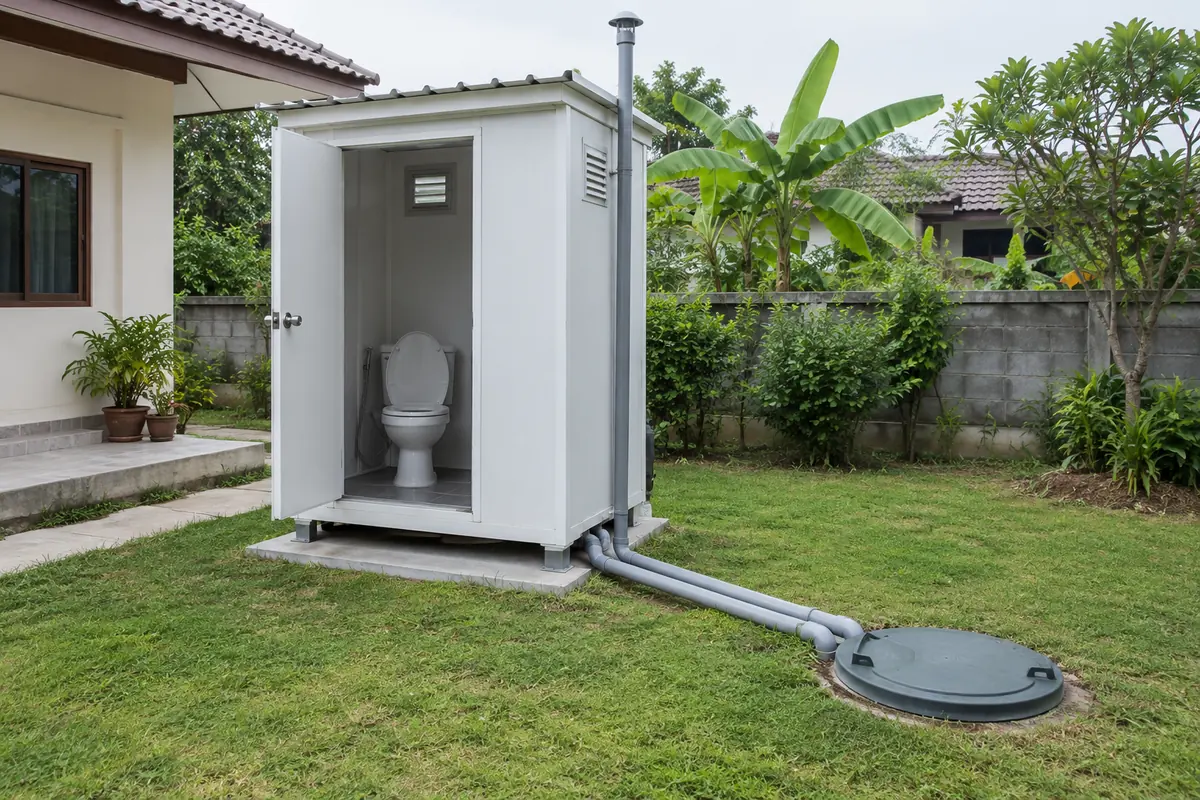
Prefab toilets: how they are installed and plumbed
What to know before placing a prefab toilet: the water supply, the drain, and a spot that is easy to maintain.
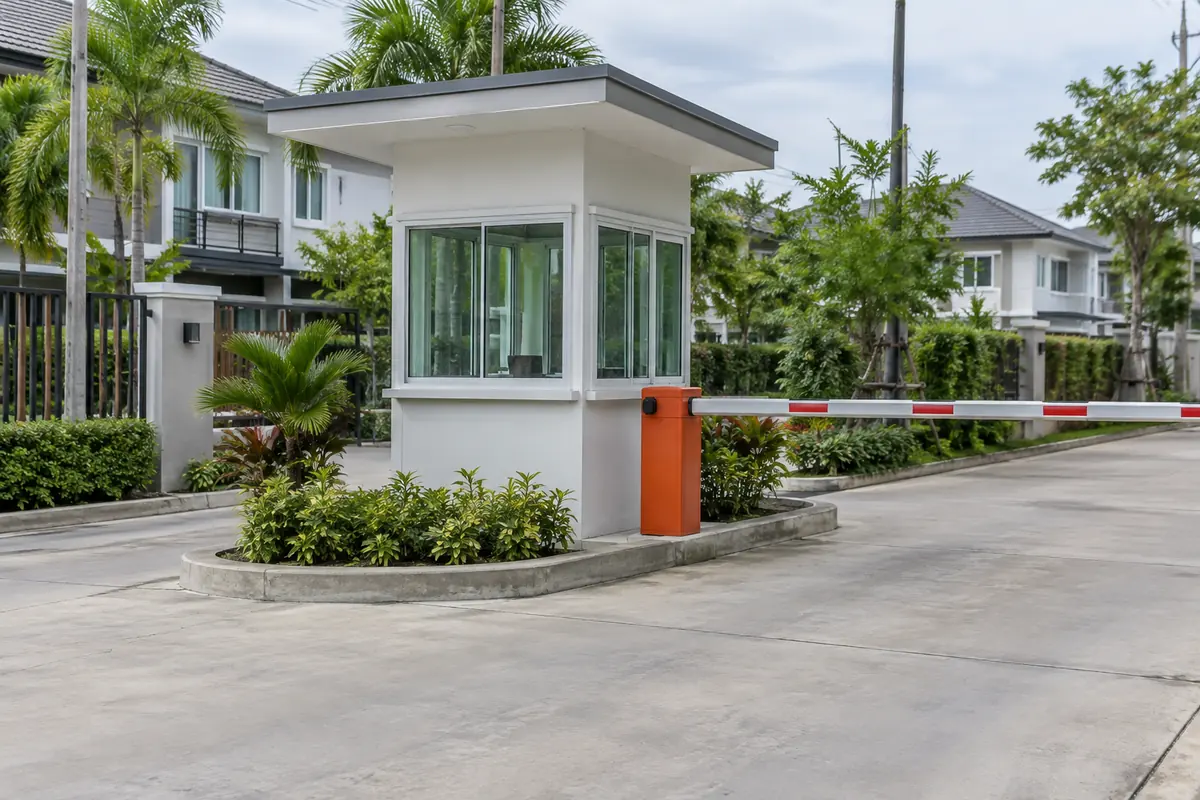
Prefab guard booths: choosing the right size
Common guard booth sizes compared with the number of staff on shift and the equipment kept inside.
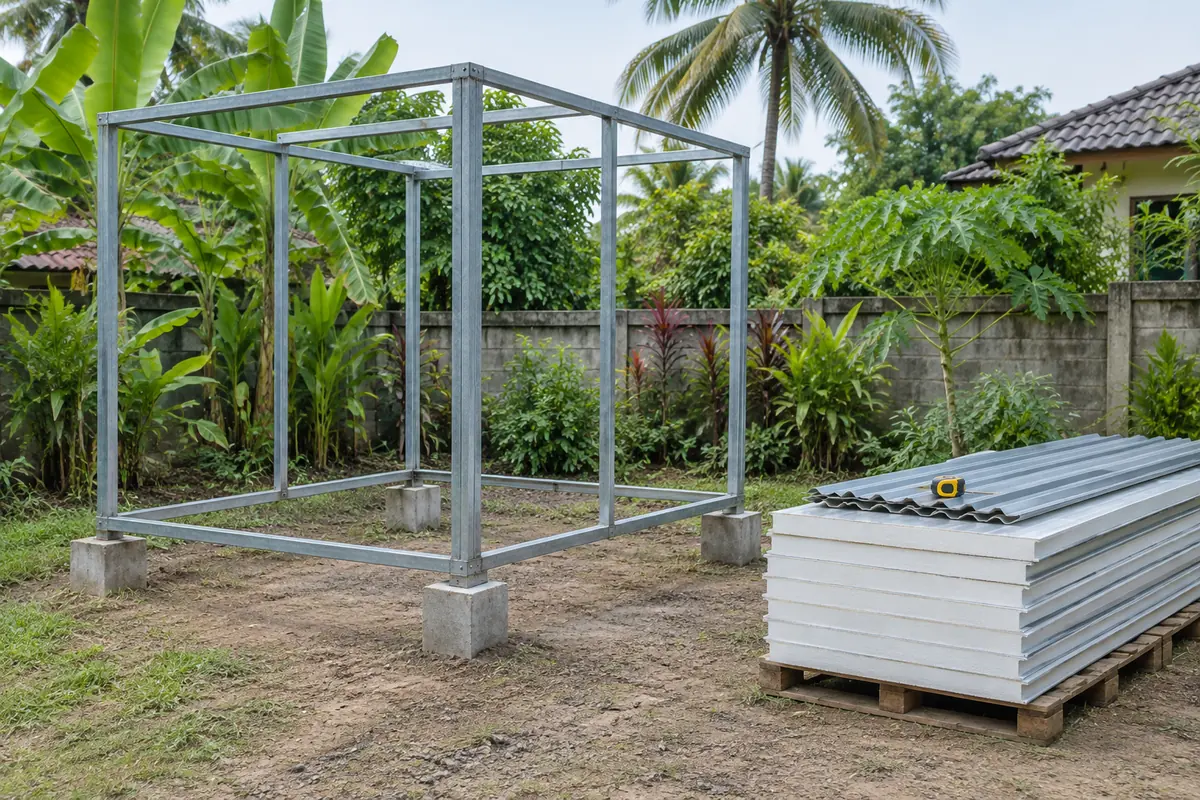
A knock-down house for ฿20,000–30,000: what can you get?
Advertised prices at ฿10,000, ฿20,000 and ฿30,000, what each level still leaves out, and a worked materials estimate for building a 2.4×2.4 m room yourself.