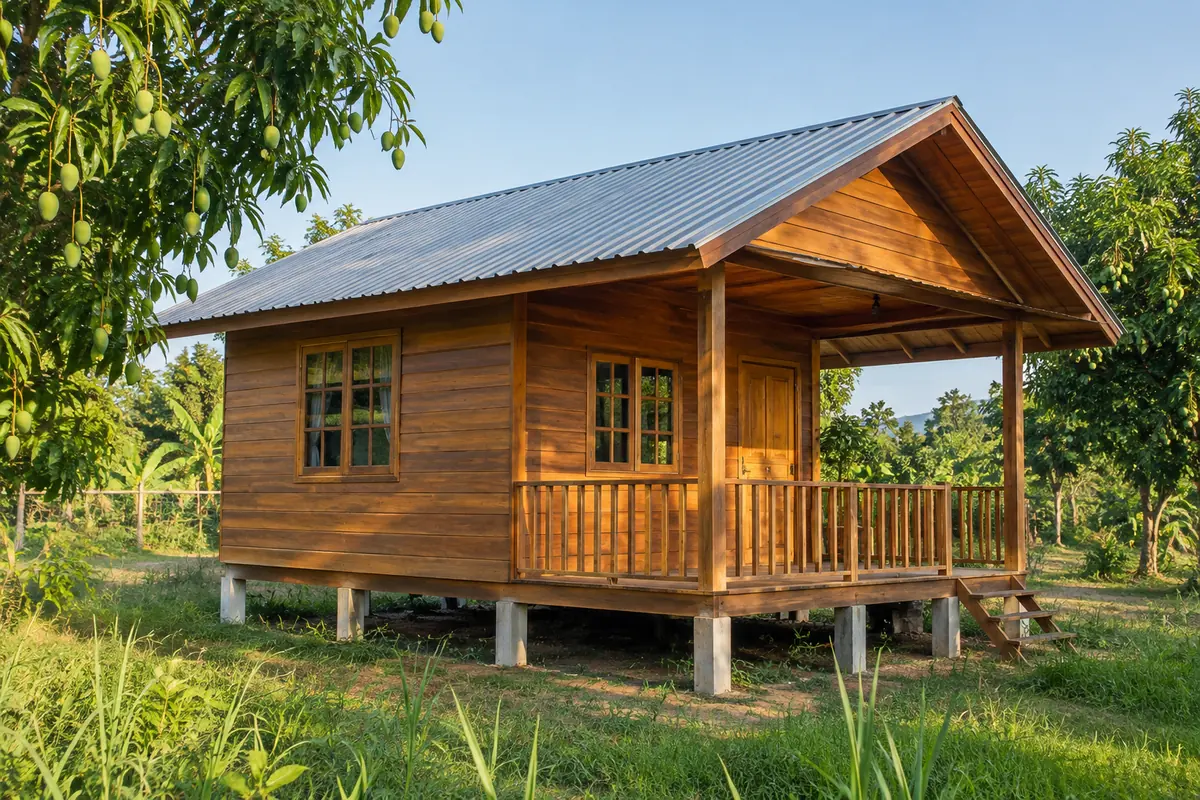
Wooden knock-down houses: how do they differ from steel frames, and how do you make them last?
Contents
In short
- Wooden knock-down houses sold in Thailand come in three kinds: solid hardwood, imported pine, and steel-framed houses clad in wood-look fibre-cement planks, which are not wood at all.
- Unlike steel frames, their main enemies are termites and damp rather than rust. Protect them with pressure-treated timber, termite-treated soil, a raised floor with no wood touching the ground, and a yearly check.
- Exterior wood finishes need recoating regularly. US data gives a single coat of wood stain about 2–4 years.
- Sellers' advertised prices (checked in November 2026) for wooden houses of 18–36 m² are about ฿249,000–409,000, depending on the wood and whether assembly is included.
The three kinds of wooden knock-down house sold in Thailand
In sales listings, "wooden knock-down house" (บ้านไม้น็อคดาวน์) covers three very different kinds of house: solid hardwood houses, imported pine houses, and steel-framed houses clad in wood-look boards. They differ from steel-framed houses in that wood is eaten by termites and rots when damp, and its surface needs recoating regularly. For other kinds of prefab house, read How many types of prefab house are there? Knock-down, modular and precast compared
| Kind | Made of | What to know before buying |
|---|---|---|
| Solid hardwood | Teak, ironwood (ไม้แดง), or old timber from demolished houses | Heartwood lasts longer than sapwood; check old timber for borer holes and termite damage |
| Imported pine | Pine from abroad, sold as a self-assembly kit or assembled by the seller | Must be pressure-treated; ask which preservative and what termite warranty |
| Steel frame, wood-look cladding | Fibre-cement planks on a steel frame | The planks do not rot and termites do not eat them, but the steel frame needs rust protection |
The third kind deserves a plain description. One listing we saw was titled "wooden house", but its specification was 5×5 inch box-steel columns, 10 mm fibre-cement planks on the outside and smartboard inside. Fibre cement is made of cement, cellulose fibre and sand or fly ash. A US builders' magazine notes that it does not rot, is not eaten by wood-boring insects and resists fire, but it is heavy and brittle, and the dust from cutting it contains silica, so a mask is needed. Choosing this kind is fine, but you should not pay a solid-wood price for it.
Wood species, heartwood and sapwood, and pressure treatment
Ministerial Regulation No. 6 (B.E. 2527, 1984) under the Building Control Act groups timber by how well it withstands the weather and borers and termites. It gives yang and tabaek as examples of softwood, pine as medium hardwood, and teng and takhian thong as hardwood. A 1974 Royal Forest Department standard, based on burying heartwood stakes in the ground, sets the natural durability of hardwood at more than 6 years and of softwood at less than 2 years.
- Heartwood and sapwood: the US Forest Products Laboratory explains that heartwood lasts longer than sapwood in damp places and is attacked less by certain insects, while sapwood takes preservative better. Timber with a lot of sapwood should therefore be treated.
- What pressure treatment is: using pressure to drive a wood preservative into the timber, instead of brushing, dipping or spraying it on the surface. The US Environmental Protection Agency says wood preservatives protect against the fungi that cause rot and against insects, including termites.
- Which preservative: the United States ended almost all residential use of CCA, which contains arsenic, at the end of 2003, and switched to copper-based preservatives such as ACQ. The same agency warns never to burn CCA-treated offcuts. Ask the seller which preservative was used.
- Treated wood can still be attacked: US university extension services note that termites can still get in through cracks and cut ends. Ask whether cuts made on site were re-treated.
Termites: the main enemy of wooden houses in Thailand
A Royal Forest Department report states that the termites causing the most damage in Thailand are subterranean termites, and the species most often found in homes in built-up areas is Coptotermes gestroi. They build mud tubes up ground beams, posts and cracks, then eat the wood from the inside first, so the surface looks normal until the damage is severe. An article by a civil engineer, citing Royal Forest Department researchers, adds that termites often enter through underground electrical conduits and that no method gives 100% protection.
- Treat the soil before the house goes in: the Royal Forest Department tested soil-applied termiticides in 4 regions and found they protected for about 7 years to more than 10 years, depending on the chemical (the longest-lasting ones are now banned). Products must be registered with the Food and Drug Administration. Ask which chemical is used and when it should be reapplied.
- No wood touching the ground: US university extension services advise that even treated wood should not touch the soil, the space under the floor should be at least 24 inches (about 60 cm) high so a person can get in to inspect, and steps and posts should stand on concrete bases.
- Termite barriers: metal shields or stainless steel mesh help, but the same sources say they should be used together with soil treatment, not instead of it.
- Check with your own eyes: look for pencil-width mud tubes on piers, posts and beams, termite wings along window sills, and wood hollowed out along the grain.
Rain, sun and damp: how often to recoat the wood
The fungi that rot wood need moisture. Work by the US Forest Products Laboratory supports the rule that wood above ground with a moisture content of no more than 20% will not rot, and that wood wetted only briefly and then dried will not rot either. The owner's job is therefore to help the wood dry quickly, with a deep enough overhang, gutters, air flow under the floor and ground that slopes away from the house.
A guide written by Purdue University with the same laboratory gives these service lives for exterior finishes.
- Water-repellent preservative: about 1–2 years.
- Penetrating semi-transparent stain: one coat on new wood about 2–4 years; two coats on rough wood may last up to 10 years in some exposures.
- Paint: one coat over a primer about 4–5 years, two coats up to 10 years.
- Clear varnish: not for outdoor use, because it cracks and peels in sun and rain, often within a year where exposure is severe.
These figures come from the US climate, and Thailand's sun and rain may shorten them. The same guide suggests sprinkling water on wood treated with a water repellent: if the water beads and runs off, the treatment is still working; if it soaks in, or the wood starts to turn grey, it is time to recoat. End grain, joints and the bottoms of door and window frames soak up water easily, so give them an extra generous coat.
Fire, weight and foundations
Wood is a combustible material. When it burns, the outer layer turns to char that insulates the wood inside. US timber design uses a burn rate of about 1.5 inches (about 38 mm) per hour in the standard fire test, so large posts and beams keep load-bearing wood for longer than thin wall boards. If there will be a kitchen, or the house will be close to other buildings, ask about the wall behind the stove and the distance between buildings. A wooden house is a building in law too; for permits see Do you need a permit to place a knock-down house on your land?
Raised wooden houses usually stand on concrete piers or posts. Ask the seller for the weight of the house, a drawing of where the piers go and the floor level needed, and never use timber posts buried in the ground as the base. For preparing the ground and supports, read Preparing your site: ground, supports and truck access
How a wooden house compares with a steel frame and sandwich panels
| Topic | Wooden house | Steel frame with sandwich panels |
|---|---|---|
| Main enemy | Termites, and fungi when the wood is damp | Rust, especially at welds and column bases |
| In a fire | Wood burns; thick pieces burn more slowly than thin boards | EPS cores burn; rock wool cores do not |
| Surface care | Recoat stain or paint every few years | Check paint and sealant once a year, repair rust spots |
| Advertised price, 3×6 m | Teak, ฿280,000, inclusions not stated | Steel frame with electrics and bathroom fittings, ฿125,000, delivery extra |
The prices in the bottom row come from different sellers, include different things, and the steel-frame listing does not state the wall type, so use them only as a rough level. For steel frames, insulation cores and rust protection, see What is a knock-down house made of, and how can you tell it is well built?
Examples of small wooden knock-down houses on sale (November 2026)
| Example | Advertised price | Included or not |
|---|---|---|
| Teak, 3×6 m (18 m²) | ฿280,000 | The listing does not say what is included |
| Pine, 1 bedroom, 23 m², self-assembly kit | ฿249,000 | Excludes assembly, painting, plumbing, wiring and delivery |
| Same model, assembled and spray-painted by the seller | ฿379,000 | Excludes plumbing, wiring and delivery; 10-year structural and 3-year termite warranty |
| Pine, 6×6 m (36 m²), same seller | ฿269,000–409,000 | The lower price is the kit, the higher is assembled; excludes plumbing, wiring and delivery |
| Solid wood, 36 m², with a bedroom and a bathroom | ฿390,000 | Includes structure, roof, floor, walls and installation; 5-year structural warranty |
| Steel frame, wood-look planks, 4×6 m with a 2×3 m veranda | ฿310,000 | Includes bathroom fittings, plumbing, wiring, footings and septic tank; delivery extra |
Price data: collected from the listing pages of wooden-house and prefab-house sellers in Thailand and from online marketplaces on 12 November 2026. Use it only as a rough guide to price levels. Prices can change, and these are not quotes we requested ourselves. None of the listings clearly states that delivery is included.
Worked example, price per m²: the 23 m² pine house assembled by the seller at ฿379,000 works out at about ฿16,500 per m², while the 36 m² house at ฿409,000 is about ฿11,400 per m². The extra 13 m² adds only ฿30,000. The self-assembly kits cost about ฿130,000–140,000 less than the assembled versions, but you have to find carpenters and paint the house yourself.
Checklists: before you buy, and every year
Before you pay a deposit
- Get the material specification in writing: what wood the frame, walls and floor are, or whether they are wood-look boards.
- Ask about treatment: which preservative, pressure-treated or just brushed on, and whether cuts made on site are re-treated.
- Ask about termite-treated soil: who does it, which chemical, and when it should be repeated.
- Check the height under the floor: can a person crawl in to inspect, and is every piece of wood clear of the ground?
- Check the eaves and gutters: how far does the roof project past the walls?
- Ask about the exterior finish: what kind of paint or stain, and when it should be recoated.
- Ask what is included: assembly, painting, wiring, plumbing and delivery.
- Get the warranty terms: structure, leaks and termites, each one separately.
Every year
- Crawl under the floor and look for mud tubes on the piers, posts and beams.
- Press or tap the wood at the bottom of door frames, in room corners and on the storeroom floor, looking for soft or hollow spots.
- Sprinkle water on the wood on the sides that get sun and rain; if it soaks in, recoat.
- Clean the gutters and look for leak stains under the roof.
- Clear away leaves, wood scraps and soil built up around the piers.
- Seal the gaps around cable conduits and pipes that go into the ground.
- If you have a contract with a termite control company, book the inspections on schedule.
Frequently asked questions
Roughly how many years will a wooden knock-down house last?
There is no single figure. It depends on the wood, the treatment, termites and keeping the wood dry. In the listings we saw, sellers gave structural warranties of 5–10 years and termite warranties of 3 years. Read the terms to see what upkeep you must do yourself.
Do termites eat wood-look fibre-cement planks?
The planks themselves are not termite food, but termites can still eat door frames, wooden trim and other wooden things in the house. If the frame inside is steel, watch for rust instead.
What should I do if I find termite mud tubes?
Call a termite control company. The civil engineer's article cited above says bait systems suit houses that are already damaged, the bait must be checked and topped up every 10–15 days, and it takes about 2–3 months to wipe out the colony.
Can I use clear varnish outside?
It is best not to. The guide cited above says clear varnish cracks and peels in sun and rain, and must be removed completely before recoating. A penetrating wood stain is easier to maintain.
Keep reading
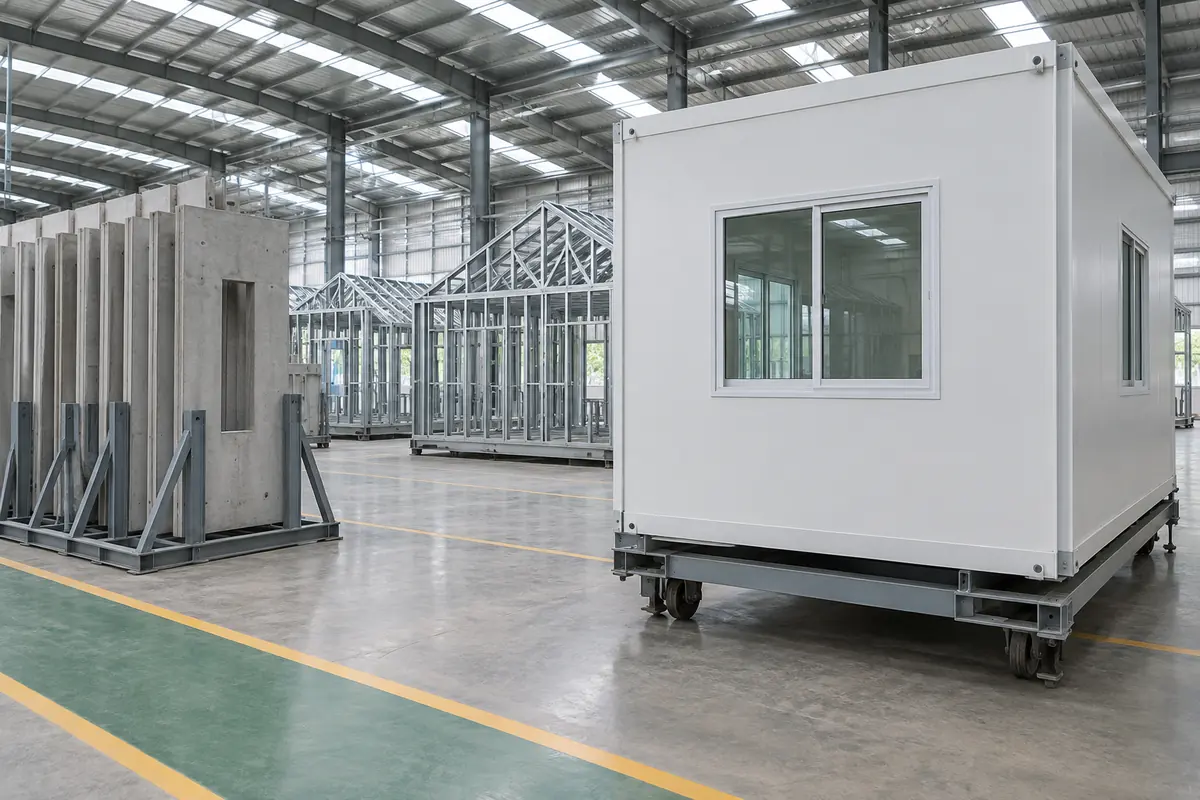
How many types of prefab house are there? Knock-down, modular and precast compared
Six kinds of prefab house sold in Thailand compared: how they are built, foundations, time on site and moving, plus their English names, permits and questions for sellers.
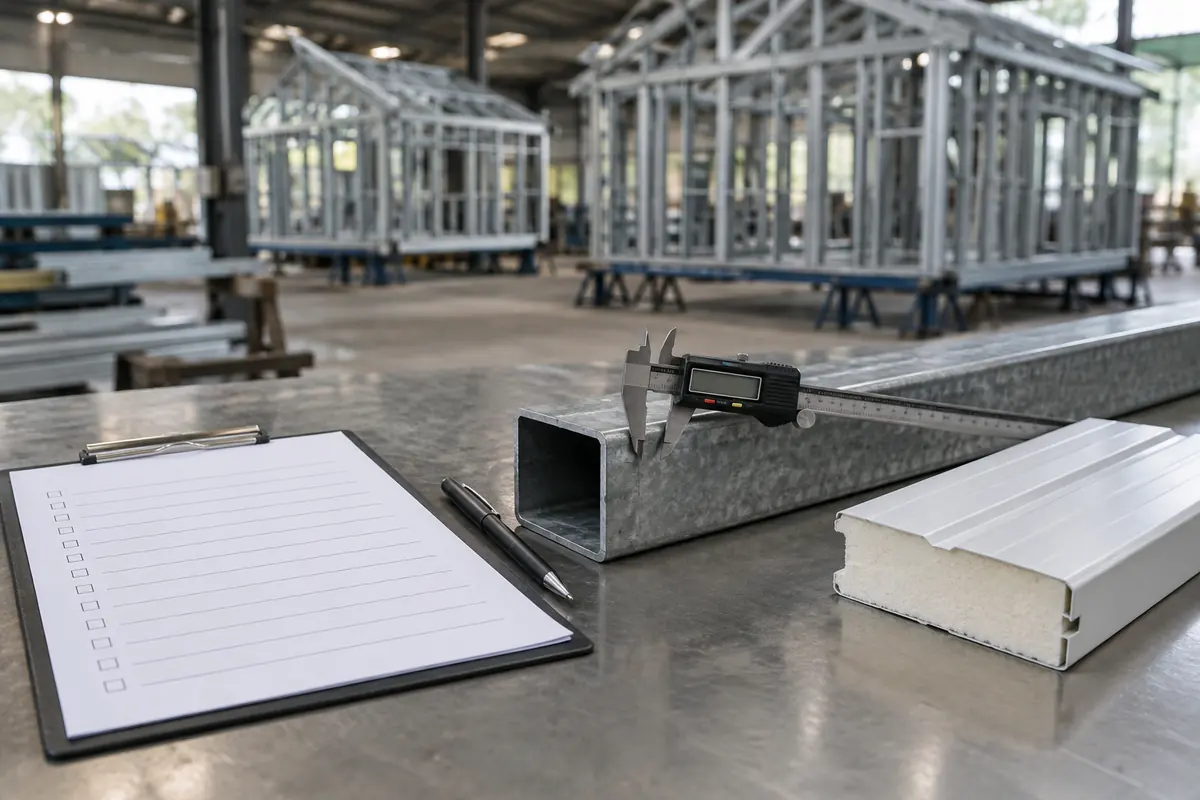
Choosing a knock-down house maker: what to check before you pay a deposit
How the three kinds of seller differ, checking a business with government tools, what the quotation and contract should contain, paying in stages, warning signs and where to complain.
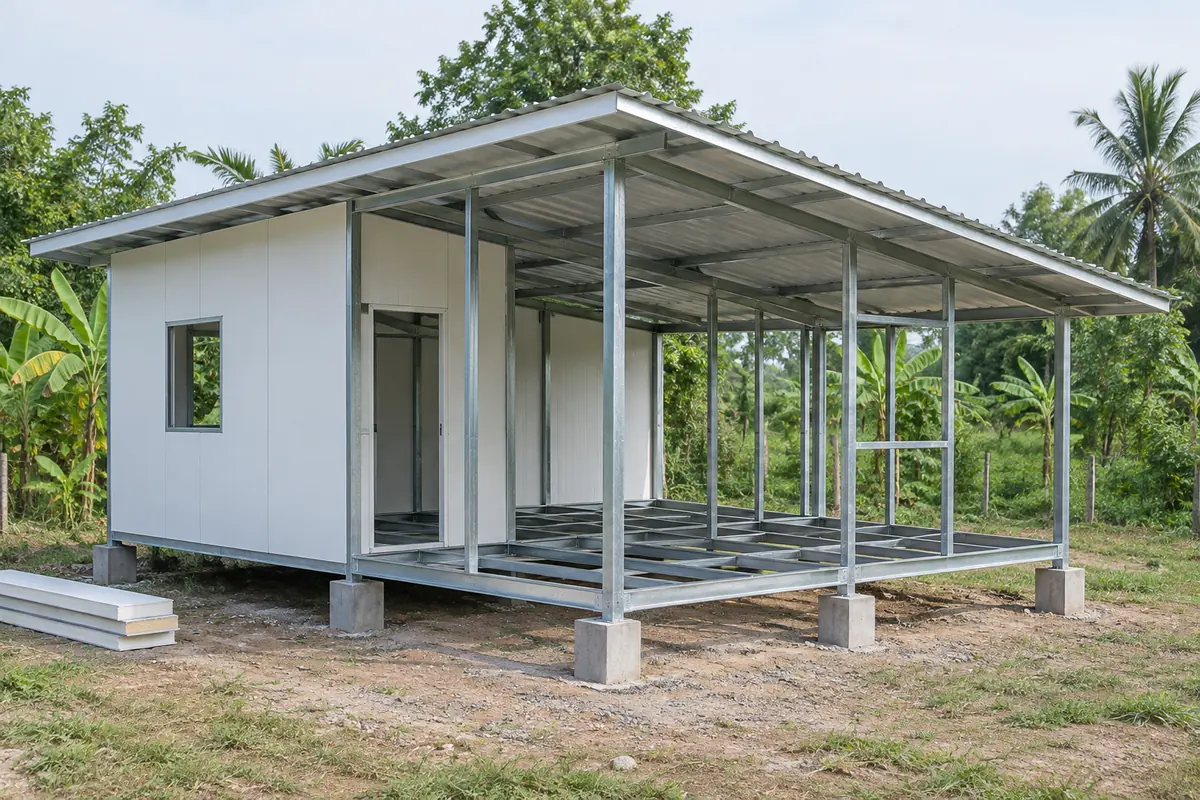
What is a knock-down house made of, and how can you tell it is well built?
A part-by-part look at the steel frame, walls, roof and floor, with questions for the seller, checks you can do yourself, and what decides how long it lasts.