Choosing a knock-down house maker: what to check before you pay a deposit
Contents
In short
- There are three main kinds of knock-down house seller: a factory that makes its own, a sales agent, and a local welding shop or contractor. They differ in how far the design can be changed and in after-sales care.
- You can check that a business exists yourself, using the online systems of the Department of Business Development and the Revenue Department, before you arrange to see its work.
- Ask for a quotation that gives materials, thicknesses, sizes and exclusions in figures, then pay in stages as the work is done, not in full on day one.
- Put the delivery date, penalties and warranty terms in the contract. If problems come up later, you can complain to the OCPB (สคบ.).
Factory, agent or welding shop: how the three kinds of seller differ
Before paying a deposit, you should be able to answer five questions. Who actually makes it? Does the business exist on the register? Have you seen finished work? Does the quotation give the specification in figures? And which part of the work is each payment tied to? We do not recommend any company, but this article gives one set of criteria for judging a knock-down house factory, a company that builds knock-down houses, or a local builder who puts them up.
The person selling to you is not necessarily the maker. Ask directly where the frame is welded and who comes to install it.
| Seller | Price and changes | After-sales | What to ask |
|---|---|---|---|
| Factory that makes its own | Usually has standard designs; changes only as far as the factory accepts | You deal with the maker directly | How long is the production queue, and are the installers staff or subcontractors? |
| Agent or online seller | The price may include the seller's margin; some compare several factories for you | Repairs go through the agent first | Which factory makes it, and who honours the warranty if the agent closes? |
| Local welding shop or contractor | Can build to a custom size; price depends on the design and materials | Close by, easy to call out | Is there a drawing and a materials list, and how many units like this have they built? |
No kind is always better. What you need to know clearly is who is responsible when something goes wrong, and that name must be in the contract.
Checking a knock-down house company with government tools
Ask the seller for the full company name, the 13-digit registration number and the office address, then check them yourself in this order.
- DBD DataWarehouse+ from the Department of Business Development: type the name or registration number of the juristic person. The system shows its status, location, registered capital, history of changes and key figures from its financial statements. The department says checks can be made 24 hours a day free of charge.
- Look at the status: it should be a juristic person that is still operating. One that has been struck off as abandoned can no longer enter into any legal transaction. If the status shows dissolved or abandoned, do not pay money in that name.
- Compare names: the registered name should match the name on the quotation, the contract and the account you are asked to pay into.
- The Revenue Department's search for VAT-registered businesses: search by the 13-digit taxpayer number or the business name. The result shows the branch, the name of the establishment, the address and the registration date, and only businesses still operating are listed.
- If the quotation adds 7% VAT: the seller should be found in the Revenue Department system. If not, ask why before you pay.
A search result is only part of the check, and a properly registered business can still do poor work. A shop run by an individual will not be in the company register, and a small shop may not be VAT-registered. In that case, make the contract with the actual owner, get a copy of their ID card and visit the shop yourself.
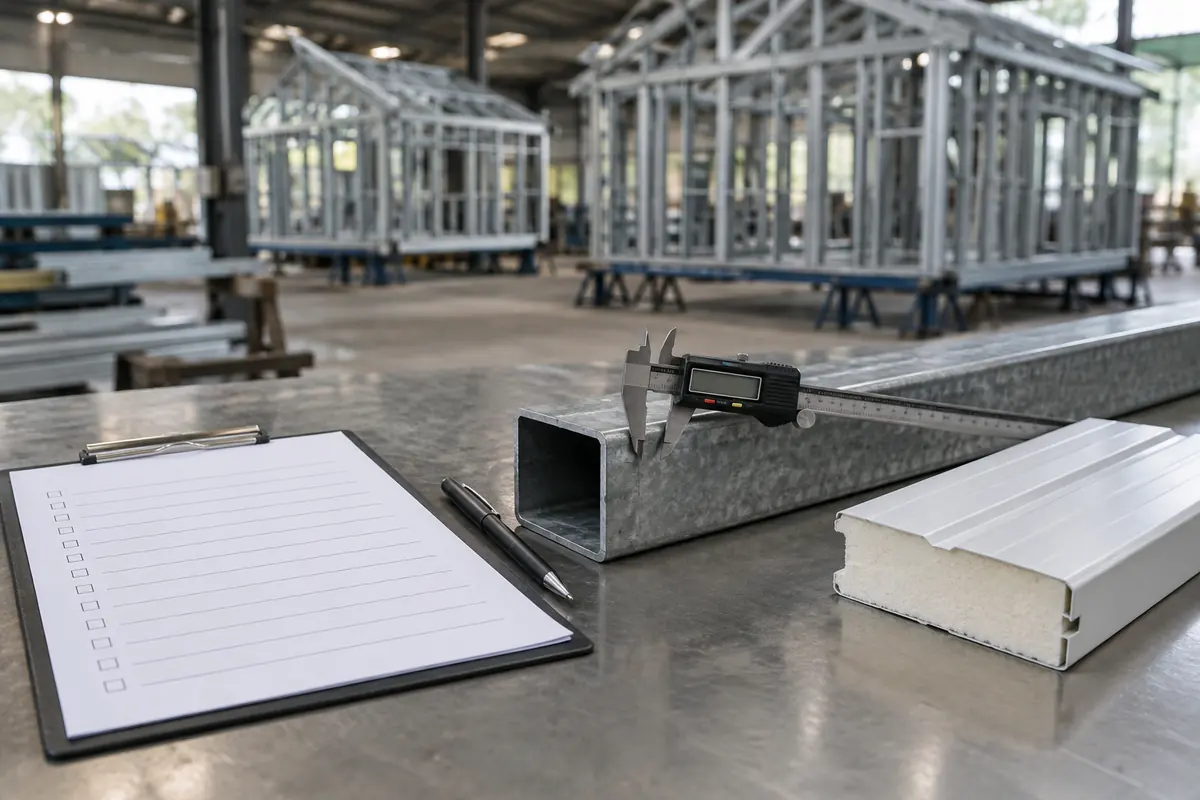
Visiting the factory or a finished unit: what to look at besides the house
Seeing the real thing tells you whether the seller has an actual workplace and does this kind of work regularly. Book ahead and go on a working day.
- Work in progress: are there frames being welded or units waiting to be delivered? If there is only an office and photos on a phone, ask where it is made.
- Materials in stock: do the steel and wall panels in the factory match the specification on the quotation you were given?
- Units already handed over: ask to see one that has been in use for a while. Rust, leaks and doors starting to stick show more clearly than on a show unit.
- Who will install it: the seller's own staff or a subcontractor, and who is responsible if something is damaged during installation?
For checking the steel frame, welds and joints with your own eyes, use the list in the article What is a knock-down house made of, and how can you tell it is well built?
What a quotation should include
A quotation you can compare must be written in figures, not words like "strong" or "good grade". If you only get photos and a total price, ask for an itemised list.
| Section | What the document should show |
|---|---|
| Size | Width, length and height, whether outside or inside, and a plan showing door and window positions |
| Frame | Size and thickness of the steel for each part, and the rust protection |
| Walls, roof, floor | Type of material, thickness and type of insulation core |
| Doors and windows | Number, size, material and insect screens |
| Electrics and water | Number of lights, sockets, breakers, and pipes if any |
| Work outside the house | Delivery, crane, supports, electricity connection, each marked included or not |
| Terms | Whether VAT is included, how long the quotation is valid, and how many days production takes |
Production times advertised by sellers vary widely, from about a week for a made-to-order frame and 15 days for a small room, up to the 60 days or less that one manufacturer gives for a whole house, depending on the design. Write the delivery date as a date, not just the word "fast".
When you have quotations from several sellers, compare them line by line. If one costs much less, find which line is missing. For example material prices, see A knock-down house for ฿20,000–30,000: what can you get?
Pay in stages tied to finished work
We found no standard deposit percentage that fits every case, and advertised terms differ too. One wall-panel maker asks for full payment in cash, some small-room sellers take payment in stages as the work proceeds on site, and some take cash on delivery.
The principle to hold on to is that each payment should match work you can check. The Contract Committee Notification making residential building construction a contract-controlled business, B.E. 2559 (2016), clause 3 (4), also requires contracts of that type to set payment stages in proportion to the work done in each stage. An example of how to split the stages:
- Contract signing: a deposit so the seller can start ordering materials.
- Frame finished: go and see it, or ask for photos and video showing the whole unit.
- Delivered to your land: check the number of pieces and any damage before you sign for it.
- Installation finished: go through everything until all the items to fix are done, and only then pay the last stage.
Only transfer to an account whose name matches the party to the contract, and keep every slip, receipt and message.
What the contract should say
The contract should answer who does what, when it will be finished, and what happens if it is not.
- The parties: names, addresses and ID numbers. For a company, attach its certificate of registration.
- What you are buying: attach the quotation, the plan and the materials list to the contract.
- Delivery date and penalties: a clear date, a daily penalty for late delivery, and the right to cancel if it is late beyond a set limit.
- Warranty: which parts are covered, such as the structure, leaks and electrics, for how many years, from what date, and how to report a repair.
- Site work: who prepares the supports, who arranges the crane, who connects the electricity, and who pays if the truck cannot get in. For what needs preparing, read Preparing your site: ground, supports and truck access
- Changes and refunds: how extra charges work if the design changes during production, and which part of the money is returned if you cancel.
Warranty periods vary a lot between sellers. One small-room listing gives a 1-year product warranty, while one house manufacturer said in an interview that it covers the structure for 3–5 years and leaks for 1 year. A promise in a chat is not enough; it must be written in the contract or a warranty document.
Where a business is hired to build a whole new building for a consumer to live in, the notification above, in force since 1 January 2017, requires the contract to include certain terms. For example, the business must be liable for defects in the structure for at least 5 years and in important fixtures or equipment for at least 1 year from handover, the penalty for late construction must be at least 0.01% of the price per day, and a term saying money will not be refunded in any case is not allowed. Whether buying a ready-made unit from a factory falls under this notification depends on the nature of the contract, so ask the OCPB. This paragraph gives general information only and is not legal advice. If a building permit is needed, state who prepares the drawings. Read more in Do you need a permit to place a knock-down house on your land?
Warning signs to stop at before you transfer money
- No address you can visit, or excuses every time you ask to see work.
- Pressure to transfer today because a promotion is ending or the queue is filling up.
- A price far below other sellers with no specification, such as a listing for a 3×6 m house at ฿25,000 that claims walls, floor, electrics, door and windows but gives no thickness figures at all.
- Contact only through chat, no company name, or an account name that does not match the seller.
- A headline price that does not match the price in the text.
- Refusal to give a written quotation or contract.
- A register status of dissolved or abandoned.
Any one of these does not always mean fraud, but it is reason enough to stop and get clear answers first.
Where to complain if something goes wrong
Start by telling the seller in writing what does not match the contract, and give them time to fix it. If that fails, the main agency is the Office of the Consumer Protection Board, or OCPB (สคบ.).
- What the OCPB does: according to its website, its Consumer Complaint Centre gives advice, receives complaints, screens them, passes them to the relevant agencies and follows up for the person who complained. In the provinces there are also provincial subcommittees that mediate consumer complaints.
- Suing on your behalf: section 39 of the Consumer Protection Act B.E. 2522 (1979) lets consumer protection officers sue on behalf of a consumer when the committee considers it beneficial, exempt from court fees. But the OCPB also considers whether the case benefits consumers as a whole.
- How to file: the OCPB online complaint system has three steps: log in, enter details of the business you are complaining about, and track the status. In the provinces, the OCPB lists provincial halls in every province as its channel.
- Evidence to prepare: the contract, quotation, transfer slips, receipts, chat messages, and dated photos of the problem.
If you were tricked into transferring money and nothing was ever delivered, report it to the police as well.
Frequently asked questions
Does buying direct from the factory always cost less than going through an agent?
Not always. The factory price may not include delivery or installation, while some agents include them. Compare the price for the unit installed on your land, and check who gives the warranty.
Is hiring a local welding shop better than buying from a factory?
It suits a custom size or land a crane cannot reach, because it can be assembled on site. But agree the design and materials list before work starts, and pay in stages tied to the work in the same way.
What deposit percentage is reasonable?
We found no standard figure that fits every case. What matters is that the money you have paid should not exceed the value of the work that is finished and can be checked. If the seller wants full payment before production, ask why, and have the contract state how you will be refunded if nothing is delivered.
Does a seller without VAT registration mean they are not trustworthy?
Not necessarily. Registration is required for businesses with income over ฿1.8 million a year, so a small shop may not be registered. But if the seller adds 7% VAT to the price, they should be found in the Revenue Department system and be able to issue a tax invoice.
Keep reading
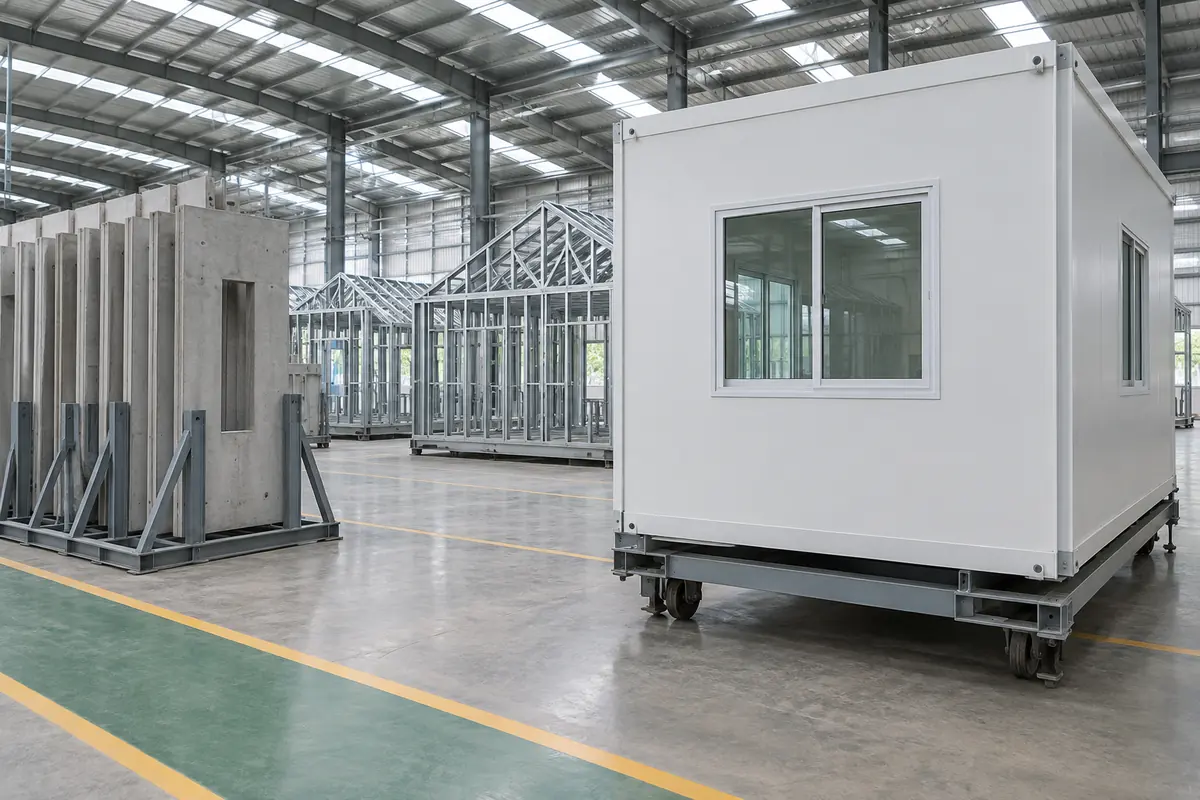
How many types of prefab house are there? Knock-down, modular and precast compared
Six kinds of prefab house sold in Thailand compared: how they are built, foundations, time on site and moving, plus their English names, permits and questions for sellers.

Wooden knock-down houses: how do they differ from steel frames, and how do you make them last?
Wooden knock-down houses in Thailand may be solid wood, pine or wood-look boards on steel. Treatment, termites, recoating, advertised prices and a yearly care checklist.
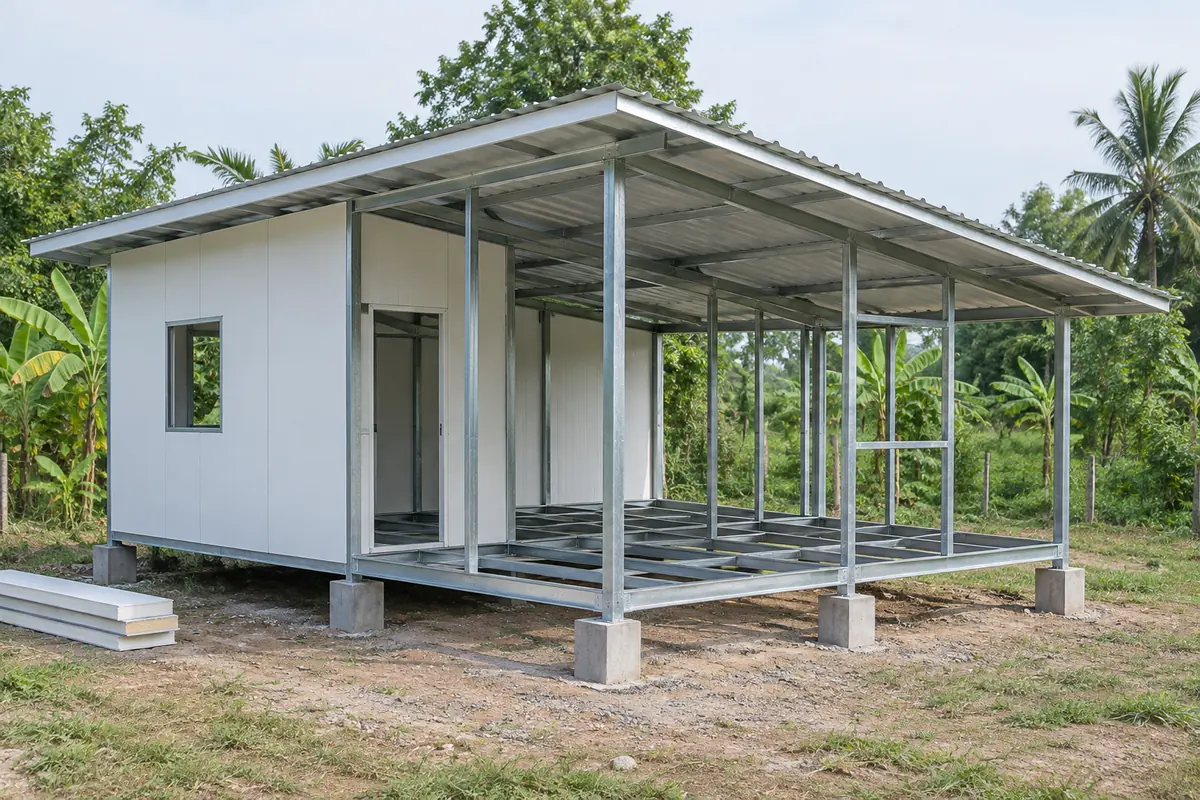
What is a knock-down house made of, and how can you tell it is well built?
A part-by-part look at the steel frame, walls, roof and floor, with questions for the seller, checks you can do yourself, and what decides how long it lasts.